Showing posts with label daring bakers. Show all posts

Saturday, January 30, 2010

Daring Bakers...and SNOW

Well, better late than never right? The first challenge I am able to do in months and I can't get it in time!


The January 2010 Daring Bakers’ challenge was hosted by Lauren of Celiac Teen. Lauren chose Gluten-Free Graham Wafers and Nanaimo Bars as the challenge for the month. The sources she based her recipe on are 101 Cookbooks and http://www.nanaimo.ca/


I didn't get this made until the weekend due to stupid sick over the week. I did attempt the homemade graham crackers, but was unable to do the gluten-free version b/c I'm trying to save money and just cannot spend that much on special flours that I will not use more than once! well, the instructions for the graham crackers say to bake them for 25 minutes. At 12 minutes there was smoke coming from the oven and my bottom rack of grahams were burnt to a crisp! I ran them outside to the snow to cool them off (smart right?) and then by the time I got back in the top rack was burnt too! I am going to try them again today...just for 11 minutes! Not sure if the special flour have something to do with the bake time, but it seems that some of the other bakers had the same issue using AP flour. Lesson learned--next time read the message boards before baking!

extra-toasty grahams

Being from Kentucky I had never heard of or tried these little Canadian treats--they are quite simple to make though (sadly i had to use store-bought grahams b/c I didn't want to go through the process of making homemade again for this--i will make them this afternoon though for my hubs!). Other than using homemade grahams, the only substitutions I made were to use vanilla pudding mix instead of "Bird's custard powder" (not to be found in these here parts) and using pecans in the base instead of almonds (i had pecans in the freezer and we're in the middle of a snowstorm! I was not going out for almonds!).

putting some filling on the bottom layer

Like some other bakers have said, these are SUPER sweet. I didn't know what to do with them all (I did make a full recipe) and then I remembered my sweet neighbor across the street. We trade baked goods a lot and he came by yesterday afternoon and offered to salt our walks and driveway for us! So nice. Later when updating hubs on the snowfall (he had to drive out of town for a wedding...very sad about it) I looked out front and was confused that the road to the left of our house was getting a tiny bit of accumulation (this is at the very beginning of the storm) but in front of our driveway it was just wet! I looked the other way and noticed the same thing and it cracked me up--our neighbor had salted the road directly in front of our houses but nothing else!
not sure if you can tell in these pictures, but if you look at the road you can see where it becomes white w/snow. heehee.
Well, i figured that was deserving of another treat, so the rest of these bars will be heading over to his family this afternoon!
As I mentioned, we got a LOT of snow this weekend! I'm just sad that hubs is out of town and can't enjoy it with us (not to mention worried about his plans to make a 3 hour drive home tonight after 10 pm when the roads will probably re-freeze!)

last night butchy loved it and jumped for joy! heehee

today..well, it touches her belly and she is not happy about that.

kitty hates it--he keeps meowing to go outside but then won't move. it's like he expects it to be gone when he goes back out. he hasn't made it more than 3 feet out the door without turning right back around and coming in.

around 6 inches i think...which is a ton for Bowling Green Kentucky!

______________________________________________
Nanaimo Bars & Graham wafers
Makes 8 x 8-inch square slab, about 24 reasonably-sized bars (or as many as you manage to slice into)

For the gluten-free graham wafers:
1 cup (138 g; 4.9 oz) sweet rice flour (also known as glutinous rice flour)
3/4 cup (100 g; 3.5 oz) tapioca starch/flour
1/2 cup (65 g; 2.3 oz) sorghum Flour
1 cup (200 g) (7.1 oz) packed dark brown sugar
1 tsp baking soda
¾ tsp kosher salt
7 tbsp (100 g; 3 ½ oz) unsalted butter, cut into 1-inch cubes and frozen
1/3 cup honey, mild-flavored such as clover.
5 tablespoons whole milk
2 tablespoons pure vanilla extract

Make the gluten-free graham wafers:
In the bowl of a food processor fitted with a steel blade, combine the flours, brown sugar, baking soda, and salt. Pulse on low to incorporate. Add the butter and pulse on and off, until the mixture is the consistency of a coarse meal. If making by hand, combine aforementioned dry ingredients with a whisk, then cut in the butter until you have a coarse meal. No chunks of butter should be visible.
In a small bowl or liquid measuring cup, whisk together the honey, milk and vanilla. Add to the flour mixture until the dough barely comes together. It will be very soft and sticky.Turn the dough onto a surface well-floured with sweet rice flour and pat the dough into a rectangle about 1 inch thick. Wrap in plastic and chill until firm, about 2 hours, or overnight.
Divide the dough in half and return one half to the refrigerator. Sift an even layer of sweet rice flour onto the work surface and roll the dough into a long rectangle, about 1/8 inch thick. The dough will be quite sticky, so flour as necessary. Cut into 4 by 4 inch squares. Gather the scraps together and set aside. Place wafers on one or two parchment-lined baking sheets. Chill until firm, about 30 to 45 minutes. Repeat with the second batch of dough.
Adjust the rack to the upper and lower positions and preheat oven to 350 degrees Fahrenheit (180 degrees Celsius).
Gather the scraps together into a ball, chill until firm, and reroll. Dust the surface with more sweet rice flour and roll out the dough to get a couple more wafers.
Prick the wafers with toothpick or fork, not all the way through, in two or more rows.
Bake for 25 minutes (12 if using all purpose flour), until browned and slightly firm to the touch, switching the shelves and rotating the sheets halfway through to ensure even baking. Might take less, and the starting location of each sheet may determine its required time. The ones that started on the bottom brown faster.
When cooled completely, place enough wafers in food processor to make 1 ¼ cups of crumbs. Another way to do this is to place the crackers in a large ziplock bag, force all air out and smash

The graham wafer dough is very sticky. Make sure you are flouring (with sweet rice flour) well, or the dough will be difficult to remove from the surface you roll it out on. Also be sure to keep it cold. You do not want the butter to melt.

You can make the graham crackers with wheat, in this case replace the gluten-free flours (the tapioca starch, sweet rice flour, and sorghum flour) with 2 ½ cups plus 2 tbsp of all-purpose wheat flour, or wheat pastry flour. Watch the wheat-based graham wafers very closely in the oven, as they bake faster than the gluten-free ones, about only 12 minutes.

For the Nanaimo bars (adapted from http://www.nanaimo.ca/):

For the bottom layer:
1/2 cup (115 g; 4 oz) unsalted butter
1/4 cup (50 g; 1.8 oz) granulated sugar
5 tablespoons unsweetened cocoa
1/8 tsp salt
1 large egg, lightly beaten
1 1/4 cups (160 g; 5.6 oz) gluten free graham wafer crumbs (or just regular graham crumbs)
1/2 cup (55 g; 1.9 ounces) sliced almonds, lightly toasted (or ½ cup rice crispies for nut-free version)
1 cup (130 g; 4.5 ounces) unsweetened dry coconut, lightly toasted

For the middle layer:
1/2 cup (115 g; 4 oz) unsalted butter, at room temperature
2 tablespoons and 2 teaspoons whipping cream
2 tablespoons vanilla custard powder (such as Bird’s, or vanilla pudding mix)
2 cups (254 g; 8.9 oz) confectioners’ sugar, sifted
1/8 tsp salt

For the top layer:
4 ounces (115 g) semi-sweet or bittersweet chocolate, finely chopped
2 tablespoons (28 g; 1 oz) unsalted butter

Preparation:
Make the bottom layer:
Line an 8 X 8-inch square baking pan with parchment paper, don’t grease the paper. Set aside.
Place the unsalted butter, sugar, cocoa, and salt in a large heatproof bowl set in a wide skillet of barely simmering water and stir frequently until the butter is melted; do not overheat. Gradually whisk in the egg and continue whisking until the mixture is thickened and reaches 160F (to remove a raw-egg issue). Remove from the heat. Stir in the crumbs, nuts (or rice crispies) and coconut. Press firmly into the prepared 8 x 8-inch square pan. Refrigerate while making the middle layer.

Make the middle layer:
In a large bowl, beat the butter, cream, custard powder (if using), icing sugar, pure vanilla extract, and salt together well until light in color. Spread over the bottom layer. Refrigerate while making the chocolate glaze.

Make the top layer:
Place all the ingredients in a small heatproof bowl set in a wide skillet of barely simmering water and stir frequently until the chocolate and butter are almost completely melted; do not overheat. Remove the glaze from the water bath and set aside to finish melting, stirring once or twice until perfectly smooth. Cool the glaze to 88-90 F. Once cool, pour over the middle layer, tilt the pan to spread the glaze. Chill thoroughly before slicing.


Tuesday, October 27, 2009

Oh NO!!

So I totally forgot to do the Daring Bakers assignment!! Or, more accurately, I forgot that today was the due date. I was planning to do them this weekend. boo. I still want to try my hand at french macaroons, but don't know when I'll make it happen. They are just so lovely...

If you are interested in how they are made be sure to check out the challenge hostess (Ami)'s site and Helen of Tartlette seems to be the unanimous blog queen when it comes to the art of macaroon making.

Sunday, September 27, 2009

Daring Bakers: Puff pastry and Vol-au-vents

The September 2009 Daring Bakers' challenge was hosted by Steph of A Whisk and a Spoon. She chose the French treat, Vols-au-Vent based on the Puff Pastry recipe by Michel Richard from the cookbook Baking With Julia by Dorie Greenspan.


So, as I previously posted, I had decided not to make this recipe, but after seeing everyone else's posts and hearing that it was actually fairly easy, I could not resist! This recipe actually is pretty easy. I had some issues w/the dough tearing as I was rolling it out and a little butter oozage, but it wasn't too crazy.


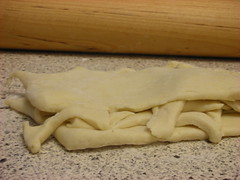
after my last turn of the dough


cut out shapes


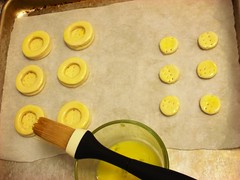
stacked w/the egg wash

For my fillings, I decided to stick on the sweet side with sweetened whipped cream and strawberries, homemade lemon curd that I had recently made, and some nutella that I have been slowly eating out of the jar w/a spoon. (shame)


nutella filling (I left the whipped cream and strawberries to the side b/c I knew that hubs wouldn't try it with any topping...he was not super impressed w/them--said that the puff pastry "didn't really taste like anything." boo on him.)


plain whipped cream w/strawberries in front, and lemon curd w/cream & strawberries in the back


side view

and top view

I was very pleased with these! They weren't too hard and look really special. I didn't get as much height as some of the other bakers, which I attribute to not refrigerating enough between turns, but all in all this was a fairly easy challenge with a "wow" factor! Thanks so much to Steph for picking this one!

--------------------------------------------------------------------------------------------------------------------------

The September 2009 Daring Bakers' Challenge has been chosen by Steph of a whisk and a spoon. Steph chose Vols-au-Vent, which we are pretty sure in French means, “After one bite we could die and go to heaven!” Wink

Puff pastry (aka pâte feuilletée) is something most of us usually buy at the grocery store, but in order to be really daring, we should make our own at least once in awhile, right? Kitchens should be getting cooler in the northern hemisphere, and are hopefully still cool-ish in the sourthern hempisphere, so I’m hoping you will all join me in making homemade puff pastry from Michel Richard’s recipe, as it appears in the book Baking with Julia by Dorie Greenspan. With our homemade puff we’ll be forming vols-au-vent cases to fill with anything we chose.

Puff pastry is in the ‘laminated dough” family, along with Danish dough and croissant dough. (In fact, if you participated in the Danish Braid challenge back in June 2008, then you already know the general procedure for working with laminated dough.) A laminated dough consists of a large block of butter (called the “beurrage”) that is enclosed in dough (called the “détrempe”). This dough/butter packet is called a “paton,” and is rolled and folded repeatedly (a process known as “turning”) to create the crisp, flaky, parallel layers you see when baked. Unlike Danish or croissant however, puff pastry dough contains no yeast in the détrempe, and relies solely aeration to achieve its high rise. The turning process creates hundreds of layers of butter and dough, with air trapped between each one. In the hot oven, water in the dough and the melting butter creates steam, which expands in the trapped air pockets, forcing the pastry to rise.

Once we have our puff pastry dough made and chilled, we are going to roll and form a portion of it into vols-au-vent, which are little puff pastry cases designed to hold a filling. I chose vols-au-vent specifically because I think they do a beautiful job of showing off the hundreds of flaky layers in the homemade puff. They can be made large enough for a full meal, or made small for little one-bite canapés, the choice is yours. Vols-au-vent are typically served hot and filled with a creamy savory filling (often poultry or seafood-based), but cold fillings, such as chicken or tuna salad, work, too. Whipped cream or pastry cream with fresh or stewed fruit often goes into sweet versions. If you are stumped for ideas for your filling(s), a quick on-line search or a glance at a traditional French cookbook will give you plenty of things to consider. I have photos of the ones I made near the bottom of this post.

Mandatory parts of the challenge: You must make Michel Richard’s recipe for puff pastry (as seen below), and form at least part of it into vols-au-vent (instructions below).

Optional parts of the challenge: You may make your vols-au-vent large or small, and may fill them with whatever you choose (savory or sweet).

Equipment:
-food processor (will make mixing dough easy, but I imagine this can be done by hand as well)
-rolling pin
-pastry brush
-metal bench scraper (optional, but recommended)
-plastic wrap
-baking sheet
-parchment paper
-silicone baking mat (optional, but recommended)
-set of round cutters (optional, but recommended)
-sharp chef’s knife
-fork
-oven
-cooling rack

Prep Times:
-about 4-5 hours to prepare the puff pastry dough (much of this time is inactive, while you wait for the dough to chill between turns…it can be stretched out over an even longer period of time if that better suits your schedule)
-about 1.5 hours to shape, chill and bake the vols-au-vent after your puff pastry dough is complete

Forming and Baking the Vols-au-Vent

Yield: 1/3 of the puff pastry recipe below will yield about 8-10 1.5” vols-au-vent or 4 4” vols-au-vent

In addition to the equipment listed above, you will need:
-well-chilled puff pastry dough (recipe below)
-egg wash (1 egg or yolk beaten with a small amount of water)
-your filling of choice

Line a baking sheet with parchment and set aside.

Using a knife or metal bench scraper, divided your chilled puff pastry dough into three equal pieces. Work with one piece of the dough, and leave the rest wrapped and chilled. (If you are looking to make more vols-au-vent than the yield stated above, you can roll and cut the remaining two pieces of dough as well…if not, then leave refrigerated for the time being or prepare it for longer-term freezer storage. See the “Tips” section below for more storage info.)

On a lightly floured surface, roll the piece of dough into a rectangle about 1/8 to 1/4-inch (3-6 mm) thick. Transfer it to the baking sheet and refrigerate for about 10 minutes before proceeding with the cutting.

(This assumes you will be using round cutters, but if you do not have them, it is possible to cut square vols-au-vents using a sharp chef’s knife.) For smaller, hors d'oeuvre sized vols-au-vent, use a 1.5” round cutter to cut out 8-10 circles. For larger sized vols-au-vent, fit for a main course or dessert, use a 4” cutter to cut out about 4 circles. Make clean, sharp cuts and try not to twist your cutters back and forth or drag your knife through the dough. Half of these rounds will be for the bases, and the other half will be for the sides. (Save any scrap by stacking—not wadding up—the pieces…they can be re-rolled and used if you need extra dough. If you do need to re-roll scrap to get enough disks, be sure to use any rounds cut from it for the bases, not the ring-shaped sides.)

Using a ¾-inch cutter for small vols-au-vent, or a 2- to 2.5-inch round cutter for large, cut centers from half of the rounds to make rings. These rings will become the sides of the vols-au-vent, while the solid disks will be the bottoms. You can either save the center cut-outs to bake off as little “caps” for you vols-au-vent, or put them in the scrap pile.

DSCN8058

Dock the solid bottom rounds with a fork (prick them lightly, making sure not to go all the way through the pastry) and lightly brush them with egg wash. Place the rings directly on top of the bottom rounds and very lightly press them to adhere. Brush the top rings lightly with egg wash, trying not to drip any down the sides (which may inhibit rise). If you are using the little “caps,” dock and egg wash them as well.
DSCN8060

Refrigerate the assembled vols-au-vent on the lined baking sheet while you pre-heat the oven to 400ºF (200ºC). (You could also cover and refrigerate them for a few hours at this point.)

Once the oven is heated, remove the sheet from the refrigerator and place a silicon baking mat (preferred because of its weight) or another sheet of parchment over top of the shells. This will help them rise evenly. Bake the shells until they have risen and begin to brown, about 10-15 minutes depending on their size. Reduce the oven temperature to 350ºF (180ºC), and remove the silicon mat or parchment sheet from the top of the vols-au-vent. If the centers have risen up inside the vols-au-vent, you can gently press them down. Continue baking (with no sheet on top) until the layers are golden, about 15-20 minutes more. (If you are baking the center “caps” they will likely be finished well ahead of the shells, so keep an eye on them and remove them from the oven when browned.)

Remove to a rack to cool. Cool to room temperature for cold fillings or to warm for hot fillings.

Fill and serve.

*For additional rise on the larger-sized vols-au-vents, you can stack one or two additional ring layers on top of each other (using egg wash to "glue"). This will give higher sides to larger vols-au-vents, but is not advisable for the smaller ones, whose bases may not be large enough to support the extra weight.

*Although they are at their best filled and eaten soon after baking, baked vols-au-vent shells can be stored airtight for a day.

*Shaped, unbaked vols-au-vent can be wrapped and frozen for up to a month (bake from frozen, egg-washing them first).

Michel Richard’s Puff Pastry Dough

From: Baking with Julia by Dorie Greenspan
Yield: 2-1/2 pounds dough

Steph’s note: This recipe makes more than you will need for the quantity of vols-au-vent stated above. While I encourage you to make the full recipe of puff pastry, as extra dough freezes well, you can halve it successfully if you’d rather not have much leftover.

There is a wonderful on-line video from the PBS show “Baking with Julia” that accompanies the book. In it, Michel Richard and Julia Child demonstrate making puff pastry dough (although they go on to use it in other applications). They do seem to give slightly different ingredient measurements verbally than the ones in the book…I listed the recipe as it appears printed in the book. http://video.pbs.org/video/1174110297/search/Pastry

Ingredients:
2-1/2 cups (12.2 oz/ 354 g) unbleached all-purpose flour
1-1/4 cups (5.0 oz/ 142 g) cake flour
1 tbsp. salt (you can cut this by half for a less salty dough or for sweet preparations)
1-1/4 cups (10 fl oz/ 300 ml) ice water
1 pound (16 oz/ 454 g) very cold unsalted butter

plus extra flour for dusting work surface

Mixing the Dough:

Check the capacity of your food processor before you start. If it cannot hold the full quantity of ingredients, make the dough into two batches and combine them.

Put the all-purpose flour, cake flour, and salt in the work bowl of a food processor fitted with a metal blade and pulse a couple of times just to mix. Add the water all at once, pulsing until the dough forms a ball on the blade. The dough will be very moist and pliable and will hold together when squeezed between your fingers. (Actually, it will feel like Play-Doh.)

Remove the dough from the machine, form it into a ball, with a small sharp knife, slash the top in a tic-tac-toe pattern. Wrap the dough in a damp towel and refrigerate for about 5 minutes.

Meanwhile, place the butter between 2 sheets of plastic wrap and beat it with a rolling pin until it flattens into a square that's about 1" thick. Take care that the butter remains cool and firm: if it has softened or become oily, chill it before continuing.

Incorporating the Butter:

Unwrap the dough and place it on a work surface dusted with all-purpose flour (A cool piece of marble is the ideal surface for puff pastry) with your rolling pin (preferably a French rolling pin without handles), press on the dough to flatten it and then roll it into a 10" square. Keep the top and bottom of the dough well floured to prevent sticking and lift the dough and move it around frequently. Starting from the center of the square, roll out over each corner to create a thick center pad with "ears," or flaps.

Place the cold butter in the middle of the dough and fold the ears over the butter, stretching them as needed so that they overlap slightly and encase the butter completely. (If you have to stretch the dough, stretch it from all over; don't just pull the ends) you should now have a package that is 8" square.

To make great puff pastry, it is important to keep the dough cold at all times. There are specified times for chilling the dough, but if your room is warm, or you work slowly, or you find that for no particular reason the butter starts to ooze out of the pastry, cover the dough with plastic wrap and refrigerate it . You can stop at any point in the process and continue at your convenience or when the dough is properly chilled.

Making the Turns:

Gently but firmly press the rolling pin against the top and bottom edges of the square (this will help keep it square). Then, keeping the work surface and the top of the dough well floured to prevent sticking, roll the dough into a rectangle that is three times as long as the square you started with, about 24" (don't worry about the width of the rectangle: if you get the 24", everything else will work itself out.) With this first roll, it is particularly important that the butter be rolled evenly along the length and width of the rectangle; check when you start rolling that the butter is moving along well, and roll a bit harder or more evenly, if necessary, to get a smooth, even dough-butter sandwich (use your arm-strength!).

With a pastry brush, brush off the excess flour from the top of the dough, and fold the rectangle up from the bottom and down from the top in thirds, like a business letter, brushing off the excess flour. You have completed one turn.

Rotate the dough so that the closed fold is to your left, like the spine of a book. Repeat the rolling and folding process, rolling the dough to a length of 24" and then folding it in thirds. This is the second turn.

Chilling the Dough:

If the dough is still cool and no butter is oozing out, you can give the dough another two turns now. If the condition of the dough is iffy, wrap it in plastic wrap and refrigerate it for at least 30 minutes. Each time you refrigerate the dough, mark the number of turns you've completed by indenting the dough with your fingertips. It is best to refrigerate the dough for 30 to 60 minutes between each set of two turns.

The total number of turns needed is six. If you prefer, you can give the dough just four turns now, chill it overnight, and do the last two turns the next day. Puff pastry is extremely flexible in this regard. However, no matter how you arrange your schedule, you should plan to chill the dough for at least an hour before cutting or shaping it.

Steph’s extra tips:

-While this is not included in the original recipe we are using (and I did not do this in my own trials), many puff pastry recipes use a teaspoon or two of white vinegar or lemon juice, added to the ice water, in the détrempe dough. This adds acidity, which relaxes the gluten in the dough by breaking down the proteins, making rolling easier. You are welcome to try this if you wish.

-Keep things cool by using the refrigerator as your friend! If you see any butter starting to leak through the dough during the turning process, rub a little flour on the exposed dough and chill straight away. Although you should certainly chill the dough for 30 to 60 minutes between each set of two turns, if you feel the dough getting to soft or hard to work with at any point, pop in the fridge for a rest.

-Not to sound contradictory, but if you chill your paton longer than the recommended time between turns, the butter can firm up too much. If this seems to be the case, I advise letting it sit at room temperature for 5-10 minutes to give it a chance to soften before proceeding to roll. You don't want the hard butter to separate into chuncks or break through the dough...you want it to roll evenly, in a continuous layer.

-Roll the puff pastry gently but firmly, and don’t roll your pin over the edges, which will prevent them from rising properly. Don't roll your puff thinner than about about 1/8 to 1/4-inch (3-6 mm) thick, or you will not get the rise you are looking for.

-Try to keep “neat” edges and corners during the rolling and turning process, so the layers are properly aligned. Give the edges of the paton a scooch with your rolling pin or a bench scraper to keep straight edges and 90-degree corners.

-Brush off excess flour before turning dough and after rolling.

-Make clean cuts. Don’t drag your knife through the puff or twist your cutters too much, which can inhibit rise.

-When egg washing puff pastry, try not to let extra egg wash drip down the cut edges, which can also inhibit rise.

-Extra puff pastry dough freezes beautifully. It’s best to roll it into a sheet about 1/8 to 1/4-inch thick (similar to store-bought puff) and freeze firm on a lined baking sheet. Then you can easily wrap the sheet in plastic, then foil (and if you have a sealable plastic bag big enough, place the wrapped dough inside) and return to the freezer for up to a few months. Defrost in the refrigerator when ready to use.

-You can also freeze well-wrapped, unbaked cut and shaped puff pastry (i.e., unbaked vols-au-vent shells). Bake from frozen, without thawing first.

-Homemade puff pastry is precious stuff, so save any clean scraps. Stack or overlap them, rather than balling them up, to help keep the integrity of the layers. Then give them a singe “turn” and gently re-roll. Scrap puff can be used for applications where a super-high rise is not necessary (such as palmiers, cheese straws, napoleons, or even the bottom bases for your vols-au-vent).
DSCN8063

You can find lots more general tips for making puff pastry on-line, including here:
http://www.baking911.com/pastry/puff.htm

I encourage everyone to watch the on-line video from the PBS show “Baking with Julia” that accompanies the book:
http://video.pbs.org/video/1174110297/search/Pastry

Thursday, August 27, 2009

august daring bakers

The August 2009 Daring Bakers' challenge was hosted by Angela of A Spoonfulof Sugar and Lorraine of Not Quite Nigella. They chose the spectacular DobosTorte based on a recipe from Rick Rodgers' cookbook Kaffeehaus: Exquisite Desserts from the Classic Caffés of Vienna, Budapest, and Prague.


so...i waited until the last possible minute to complete this month's challenge! between initally being terrified of attempting this, to then not being able to find some ingredients, (have i ever mentioned that bowling green is not a place for speciality ingredients? no superfine sugar or hazlenuts to be found...), and then getting sick and not feeling at all up to anything with such long instructions, it has been quite a challenge!

i completed the buttercream on sunday night. i had read from a lot of other DBers that their buttercream melted and wouldn't hold together, so i determined to make it in advance and give it plenty of time to chill. well, i honestly didn't intend to let it chill for 3 whole days, but whatever! by the time i was ready to use it, i actually had to let it sit out for a while and let it soften up before it was even spreadable!


for the sponge layers, rather than using the technique in the instructions, i took another cue f/m the forums and baked each layer in disposable aluminum pans. this meant that i didn't have to trim the layers or wait for pans to cool--it worked really well!

sponge batter

prepared pans

a finished layer

i went ahead and put the torte together, and then let it cool in the fridge while i made the caramel. i actually thought this came together pretty well! it wasn't the most even or smooth cake, but it didn't fall apart or lean like some others that i'd seen!


then came the dreaded caramel layer. i heard that the lemon was a gross flavor, so i cut the amount from 8(!) teaspoons to 3, but i think that was still way too much! i also had some issues with the syrup mixture bubbling over--it actually caught something on fire (just for a second) in the burner plates on my stove and then the smoke alarm went off!! yikes! when it finally got to the "amber-colored caramel" it was supposed to reach i poured it over the sponge layers...and managed to pour a bit on my finger--ouch ouch ouch!!!! i tried a bit of it after the pain stopped, and it was....GROSS! oh well...at least i tried it!

the scored cake wedges topped w/caramel


the completed dobos torte

i assebled the dobos as instructed and snapped a picture, but the wedges were too heavy and the icing too soft...so i promptly removed them and tossed them in the trash!

i sloppily piped the leftover buttercream on the top for a bit of decoration, and then got to try it!


it's pretty good--the sponge cake is kinda dry by nature, but the icing and sponge taste well together...and the macadamia nuts that i used (a gift f/m MIL after her hawaii vacation) added a nice crunchy texture.

all in all, this was a daring challenge! i did several things i have never done before: made a buttercream using eggs, made sponge cake, and made caramel! thanks to Angela and Lorraine for picking something that was truly a challenge! be sure to check out the Daring Baker's blog roll to see how everyone else did!

and now...for the history and instructions:
-------------------------------------------------------------------------------------------------

So, what is the Dobos Torta (or Torte)?

Dobos torta

The Dobos Torta is a five-layer sponge cake, filled with a rich chocolate buttercream and topped with thin wedges of caramel. (You may come across recipes which have anywhere between six and 12 layers of cake; there are numerous family variations!) It was invented in 1885 by József C. Dobos, a Hungarian baker, and it rapidly became famous throughout Europe for both its extraordinary taste and its keeping properties. The recipe was a secret until Dobos retired in 1906 and gave the recipe to the Budapest Confectioners' and Gingerbread Makers' Chamber of Industry, providing that every member of the chamber can use it freely.

Lorraine and I would like you to make this famous cake which we chose in the spirit of being Daring and Challenging us. Variations are discussed at the end of this post and as always, if you have to make substitutions for dietary or financial reasons, that is fine.

Equipment

  • 2 baking sheets
  • 9” (23cm) springform tin and 8” cake tin, for templates
  • mixing bowls (1 medium, 1 large)
  • a sieve
  • a double boiler (a large saucepan plus a large heat-proof mixing bowl which fits snugly over the top of the pan)
  • a small saucepan
  • a whisk (you could use a balloon whisk for the entire cake, but an electric hand whisk or stand mixer will make life much easier)
  • metal offset spatula
  • sharp knife
  • a 7 1/2” cardboard cake round, or just build cake on the base of a sprinfrom tin.
  • piping bag and tip, optional

Prep times

  • Sponge layers 20 mins prep, 40 mins cooking total if baking each layer individually.
  • Buttercream: 20 mins cooking. Cooling time for buttercream: about 1 hour plus 10 minutes after this to beat and divide.
  • Caramel layer: 10-15 minutes.
  • Assembly of whole cake: 20 minutes

Sponge cake layers

  • 6 large eggs, separated, at room temperature
  • 1 1/3 cups (162g) confectioner's (icing) sugar, divided
  • 1 teaspoon (5ml) vanilla extract
  • 1 cup plus 2 tablespoons (112g) sifted cake flour (SUBSTITUTE 95g plain flour + 17g cornflour (cornstarch) sifted together)
  • pinch of salt

Chocolate Buttercream

  • 4 large eggs, at room temperature
  • 1 cup (200g) caster (ultrafine or superfine white) sugar
  • 4oz (110g) bakers chocolate or your favourite dark chocolate, finely chopped
  • 2 sticks plus 2 tablespoons (250g) unsalted butter, at room temperature.

Caramel topping

  • 1 cup (200g) caster (superfine or ultrafine white) sugar
  • 12 tablespoons (180 ml) water
  • 8 teaspoons (40 ml) lemon juice
  • 1 tablespoon neutral oil (e.g. grapeseed, rice bran, sunflower)

Finishing touches

  • a 7” cardboard round
  • 12 whole hazelnuts, peeled and toasted
  • ½ cup (50g) peeled and finely chopped hazelnuts

Directions for the sponge layers:

NB. The sponge layers can be prepared in advance and stored interleaved with parchment and well-wrapped in the fridge overnight.

1.Position the racks in the top and centre thirds of the oven and heat to 400F (200C).
2.Cut six pieces of parchment paper to fit the baking sheets. Using the bottom of a 9" (23cm) springform tin as a template and a dark pencil or a pen, trace a circle on each of the papers, and turn them over (the circle should be visible from the other side, so that the graphite or ink doesn't touch the cake batter.)
3.Beat the egg yolks, 2/3 cup (81g) of the confectioner's (icing) sugar, and the vanilla in a medium bowl with a mixer on high speed until the mixture is thick, pale yellow and forms a thick ribbon when the beaters are lifted a few inches above the batter, about 3 minutes. (You can do this step with a balloon whisk if you don't have a mixer.)

4.In another bowl, using clean beaters, beat the egg whites until soft peaks form. Gradually beat in the remaining 2/3 cup (81g) of confectioner's (icing)sugar until the whites form stiff, shiny peaks. Using a large rubber spatula, stir about 1/4 of the beaten whites into the egg yolk mixture, then fold in the remainder, leaving a few wisps of white visible. Combine the flour and salt. Sift half the flour over the eggs, and fold in; repeat with the remaining flour.
5.Line one of the baking sheets with a circle-marked paper. Using a small offset spatula, spread about 3/4cup of the batter in an even layer, filling in the traced circle on one baking sheet. Bake on the top rack for 5 minutes, until the cake springs back when pressed gently in the centre and the edges are lightly browned. While this cake bakes, repeat the process on the other baking sheet, placing it on the centre rack. When the first cake is done, move the second cake to the top rack. Invert the first cake onto a flat surface and carefully peel off the paper. Slide the cake layer back onto the paper and let stand until cool. Rinse the baking sheet under cold running water to cool, and dry it before lining with another parchment. Continue with the remaining papers and batter to make a total of six layers. Completely cool the layers. Using an 8" springform pan bottom or plate as a template, trim each cake layer into a neat round. (A small serrated knife is best for this task.)

Directions for the chocolate buttercream:

NB. This can be prepared in advance and kept chilled until required.

1.Prepare a double-boiler: quarter-fill a large saucepan with water and bring it to a boil.
2.Meanwhile, whisk the eggs with the sugar until pale and thickened, about five minutes. You can use a balloon whisk or electric hand mixer for this.
3.Fit bowl over the boiling water in the saucepan (water should not touch bowl) and lower the heat to a brisk simmer. Cook the egg mixture, whisking constantly, for 2-3 minutes until you see it starting to thicken a bit. Whisk in the finely chopped chocolate and cook, stirring, for a further 2-3 minutes.
4.Scrape the chocolate mixture into a medium bowl and leave to cool to room temperature. It should be quite thick and sticky in consistency.
5.When cool, beat in the soft butter, a small piece (about 2 tablespoons/30g) at a time. An electric hand mixer is great here, but it is possible to beat the butter in with a spatula if it is soft enough. You should end up with a thick, velvety chocolate buttercream. Chill while you make the caramel topping.

Lorraine's note: If you're in Winter just now your butter might not soften enough at room temperature, which leads to lumps forming in the buttercream. Male sure the butter is of a very soft texture I.e. running a knife through it will provide little resistance, before you try to beat it into the chocolate mixture. Also, if you beat the butter in while the chocolate mixture is hot you'll end up with more of a ganache than a buttercream!

Directions for the caramel topping:

1.Choose the best-looking cake layer for the caramel top. To make the caramel topping: Line a jellyroll pan with parchment paper and butter the paper. Place the reserved cake layer on the paper. Score the cake into 12 equal wedges. Lightly oil a thin, sharp knife and an offset metal spatula.
2.Stir the sugar, water and lemon juice in a small saucepan. Bring to a boil over a medium heat, stirring often to dissolve the sugar. Once dissolved into a smooth syrup, turn the heat up to high and boil without stirring, swirling the pan by the handle occasionally and washing down any sugar crystals on the sides of the pan with a wet brush until the syrup has turned into an amber-coloured caramel.
3.The top layer is perhaps the hardest part of the whole cake so make sure you have a oiled, hot offset spatula ready. I also find it helps if the cake layer hasn't just been taken out of the refrigerator. I made mine ahead of time and the cake layer was cold and the toffee set very, very quickly—too quickly for me to spread it. Immediately pour all of the hot caramel over the cake layer. You will have some leftover most probably but more is better than less and you can always make nice toffee pattern using the extra to decorate. Using the offset spatula, quickly spread the caramel evenly to the edge of the cake layer. Let cool until beginning to set, about 30 seconds. Using the tip of the hot oiled knife (keep re-oiling this with a pastry brush between cutting), cut through the scored marks to divide the caramel layer into 12 equal wedges. Cool another minute or so, then use the edge of the knife to completely cut and separate the wedges using one firm slice movement (rather than rocking back and forth which may produce toffee strands). Cool completely.

Angela's note: I recommend cutting, rather than scoring, the cake layer into wedges before covering in caramel (reform them into a round). If you have an 8” silicon round form, then I highly recommend placing the wedges in that for easy removal later and it also ensures that the caramel stays on the cake layer. Once set, use a very sharp knife to separate the wedges.

Assembling the Dobos

1.Divide the buttercream into six equal parts.
2.Place a dab of chocolate buttercream on the middle of a 7 1/2” cardboard round and top with one cake layer. Spread the layer with one part of the chocolate icing. Repeat with 4 more cake layers. Spread the remaining icing on the sides of the cake.
3.Optional: press the finely chopped hazelnuts onto the sides of the cake.
4.Propping a hazelnut under each wedge so that it sits at an angle, arrange the wedges on top of the cake in a spoke pattern. If you have any leftover buttercream, you can pipe rosettes under each hazelnut or a large rosette in the centre of the cake. Refrigerate the cake under a cake dome until the icing is set, about 2 hours. Let slices come to room temperature for the best possible flavour.

Storage

I (Angela) am quite happy to store this cake at room temperature under a glass dome, but your mileage may vary. If you do decide to chill it, then I would advise also using a glass dome if you have done. I should also note that the cake will cut more cleanly when chilled.

Variations

Shape: The traditional shape of a Dobos Torta is a circular cake, but you can vary the shape and size if you want. Sherry Yard in Desserts By The Yard makes a skyscraper Dobos by cutting a full-size cake into four wedges and stacking them to create a tall, sail-shaped cake. Mini Dobos would be very cute, and you could perch a little disc of caramel on top.

Flavour: While we both love the dark chocolate buttercream and this is traditional, we think it would be fun to see what fun buttercreams you all come up with! So, go wild! Or, you could brush each layer with a flavoured syrup if you just want a hint of a second flavour. Cointreau syrup would be divine!

Nuts: These are optional for decoration, so no worries if you're allergic to them. If you don't like hazelnuts, then substitute for another variety that you like.

Egg concerns

The cooking process for the buttercream will produce lightly cooked eggs. If you fall into a vulnerable health group then you may wish to use an egg-less buttercream.

Resources
http://cafechocolada.blogspot.com/2008/04/dobos-torte.html
http://books.google.co.uk/books?id=4VHMjIfxfYcC&pg=PA240&lpg=PA240&dq=%22dobos+torte%22&source=bl&ots=tcE2j8dTLl&sig=QoPANOL_MJnfi_vmHm5rW2ncC60&hl=en&ei=jidySrbpKeG2jAec58mODA&sa=X&oi=book_result&ct=result&resnum=7
http://paulaerbay2.wordpress.com/2007/07/24/dobos-torte-recipe/

Pictures

http://www.flickr.com/photos/zaykivi/1461855790/
http://www.flickr.com/photos/moemegan/91029833/
http://www.flickr.com/photos/kisima/331016996/
http://www.flickr.com/photos/the_cupcake_store/2500169495/

***UPDATE***
I've created a .pdf file of this post for easier printing.. I do this for the recipe archives, but since I shocked myself by being on the ball this month, I thought I'd attach it to this post in case any of you can use it. Smile xoxo

Sunday, July 26, 2009

First ever Daring Bakers Challenge!

I have been waiting to join the Daring Bakers group for a few months and am so excited to have finally gotten to participate in a challenge! For those of you who don't know, the Daring Kitchen is an online community for cooks and bakers all over the world who come together and make the same recipe each month. then on the same day, each blogging member posts their challenge results along with the recipe. It is a super fun community designed to challenge us in the kitchen to make things that we would not normally do. Everyone has such wonderful tips and ideas and alterations to the recipes, it can be a little intimidating, but is super fun!

I really wanted to make both recipes this month and was all prepared to make the mallows today (sunday), but time and a dirty house decided otherwise, so i have only completed the Milanos. I've included both recipes though, and you can check out the blogroll to see the other Daring Bakers' results.

The July Daring Bakers' challenge was hosted by Nicole at Sweet Tooth. She chose Chocolate Covered Marshmallow Cookies and Milan Cookies from pastry chef Gale Gand of the Food Network.


The Milanos were not super hard to make. The most difficult part was getting consistent shapes for the piped cookies. I attempted to make one sheet pan in a circular shape rather than the traditional oval, and they spread like crazy! I ended up having to cut them and try to match the sizes up to fill them. I also did not get mine crisp enough--it is very important to let them brown on the edges! i think an additional 5 minutes added to the bake time would have been perfect.

A lot of the bakers experimented with flavors, both in the cookie and chocolates. Some added other fruits like rasperry extrac or coconut rather than lemon, or just vanilla. I would like to make these again with more variations, b/c the citrus is a bit too strong for me.

I regret not taking more pictures of the process--i intended to do that with the mallows, but since they didn't get done...oh well. My coworkers seemed to enjoy the ones i took to work, and my sister ate up the remaining cookies at my house, so i think they were a success!


Milan Cookies
Recipe courtesy Gale Gand, from Food Network website

Prep Time: 20 min
Inactive Prep Time: 0 min
Cook Time: 1 hr 0 min
Serves: about 3 dozen cookies

• 12 tablespoons (170grams/ 6 oz) unsalted butter, softened
• 2 1/2 cups (312.5 grams/ 11.02 oz) powdered sugar
• 7/8 cup egg whites (from about 6 eggs)
• 2 tablespoons vanilla extract
• 2 tablespoons lemon extract
• 1 1/2 cups (187.5grams/ 6.61 oz) all purpose flour
• Cookie filling, recipe follows

Cookie filling:
• 1/2 cup heavy cream
• 8 ounces semisweet chocolate, chopped
• 1 orange, zested

1. In a mixer with paddle attachment cream the butter and the sugar.
2. Add the egg whites gradually and then mix in the vanilla and lemon extracts.
3. Add the flour and mix until just well mixed.
4. With a small (1/4-inch) plain tip, pipe 1-inch sections of batter onto a parchment-lined sheet pan, spacing them 2 inches apart as they spread.
5. Bake in a preheated 350 degree oven for 10 minutes or until light golden brown around the edges. Let cool on the pan.
6. While waiting for the cookies to cool, in a small saucepan over medium flame, scald cream.
7. Pour hot cream over chocolate in a bowl, whisk to melt chocolate, add zest and blend well.
8. Set aside to cool (the mixture will thicken as it cools).
9. Spread a thin amount of the filling onto the flat side of a cookie while the filling is still soft and press the flat side of a second cookie on top.
10. Repeat with the remainder of the cookies.


Mallows(Chocolate Covered Marshmallow Cookies)
Recipe courtesy Gale Gand, from Food Network website
Chocolate Covered Marshmallow Cookies
Prep Time: 10 min
Inactive Prep Time: 5 min
Cook Time: 10 min
Serves: about 2 dozen cookies

• 3 cups (375grams/13.23oz) all purpose flour
• 1/2 cup (112.5grams/3.97oz) white sugar
• 1/2 teaspoon salt
• 3/4 teaspoon baking powder
• 3/8 teaspoon baking soda
• 1/2 teaspoon ground cinnamon
• 12 tablespoons (170grams/ 6 oz) unsalted butter
• 3 eggs, whisked together
• Homemade marshmallows, recipe follows
• Chocolate glaze, recipe follows

1. In a mixer with the paddle attachment, blend the dry ingredients.
2. On low speed, add the butter and mix until sandy.
3. Add the eggs and mix until combine.
4. Form the dough into a disk, wrap with clingfilm or parchment and refrigerate at least 1 hour and up to 3 days.
5. When ready to bake, grease a cookie sheet or line it with parchment paper or a silicon mat.
6. Preheat the oven to 375 degrees F.
7. Roll out the dough to 1/8-inch thickness, on a lightly floured surface. Use a 1 to 1 1/2 inches cookie cutter to cut out small rounds of dough.
8. Transfer to the prepared pan and bake for 10 minutes or until light golden brown. Let cool to room temperature.
9. Pipe a “kiss” of marshmallow onto each cookie. Let set at room temperature for 2 hours.
10. Line a cookie sheet with parchment or silicon mat.
11. One at a time, gently drop the marshmallow-topped cookies into the hot chocolate glaze.
12. Lift out with a fork and let excess chocolate drip back into the bowl.
13. Place on the prepared pan and let set at room temperature until the coating is firm, about 1 to 2 hours.

Note: if you don’t want to make your own marshmallows, you can cut a large marshmallow in half and place on the cookie base. Heat in a preheated 350-degree oven to slump the marshmallow slightly, it will expand and brown a little. Let cool, then proceed with the chocolate dipping.

Homemade marshmallows:
• 1/4 cup water
• 1/4 cup light corn syrup
• 3/4 cup (168.76 grams/5.95oz) sugar
• 1 tablespoon powdered gelatin
• 2 tablespoons cold water
• 2 egg whites , room temperature
• 1/4 teaspoon pure vanilla extract

1. In a saucepan, combine the water, corn syrup, and sugar, bring to a boil until “soft-ball” stage, or 235 degrees on a candy thermometer.
2. Sprinkle the gelatin over the cold water and let dissolve.
3. Remove the syrup from the heat, add the gelatin, and mix.
4. Whip the whites until soft peaks form and pour the syrup into the whites.
5. Add the vanilla and continue whipping until stiff.
6. Transfer to a pastry bag.

Chocolate glaze:
• 12 ounces semisweet chocolate
• 2 ounces cocoa butter or vegetable oil

1. Melt the 2 ingredients together in the top of a double boiler or a bowl set over barely simmering water.